“Parts of Speech: Where Words Find Their Job.”
The Fun-filled Parts of Speech !
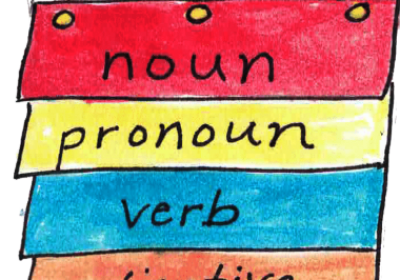
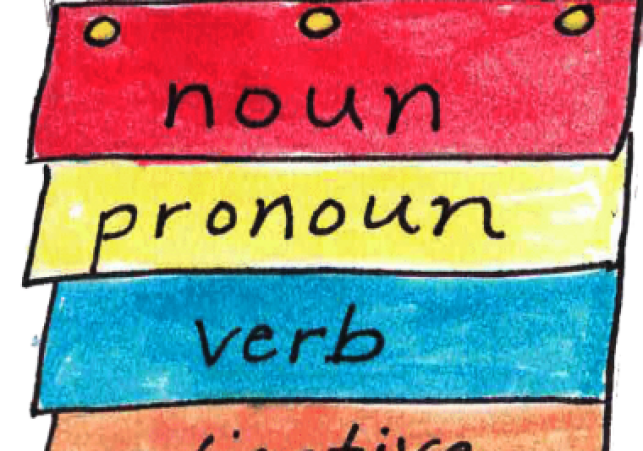
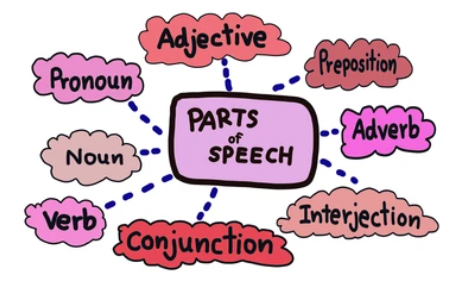
‘Parts of Speech’ are the basic categories of words in English grammar based on the function they perform in a sentence. Every word plays a specific role, such as naming something, showing action, describing, or joining ideas. The main parts of speech are noun, pronoun, verb, adjective, adverb, preposition, conjunction, and interjection. Understanding parts of speech helps students form correct sentences, understand meanings clearly, and use language accurately in speaking and writing.
Now, let us dive deep into something more interesting!
ULTIMATE MEMORY FORMULA
Sentence Trick:
Naughty Penguins Visit Angry Angry Pink Cats Instantly
Where-
N- stands for Noun
P- stands for Pronoun
V- stands for Verb
A- stands for Adverb
A- stands for Adjectives
P- stands for Preposition
C- stands for Conjunction
I- stands for Interjection
Let us start with the basics, what say?
NOUN – ‘NAME GAME’
A noun is the name of a person, place, animal, thing, or idea. A simple shortcut to identify a noun is to ask yourself, “Can I name it?” If the answer is yes, it is most likely a noun. Nouns include things we can touch, like school or dog, and also things we can only think about, like honesty or happiness. Examples of nouns are Riya, school, dog, honesty, and happiness.
The magic line to remember is: “Nouns are names—nothing more, nothing less!”
PRONOUN – ‘REPLACEMENT STAR’
A pronoun is a word that replaces a noun in a sentence. Pronouns are used to avoid repeating the same noun again and again. A fun way to identify a pronoun is to read the sentence twice—if replacing a name with a word like he, she, it, or they sounds smooth and natural, that word is a pronoun. For example, Riya is absent. She is ill.
The magic line to remember is: “Pronouns save us from name-game repetition!”
VERB – ‘ACTION OR STATE HERO’
A verb shows an action or a state of being. It tells us what the subject of the sentence is doing or being. To find a verb, ask the question, “What is the subject doing or being?” Words like run, eat, think, is, are, and was are all verbs. Every sentence must have a verb to make sense.
The magic line to remember is: “No verb, no sentence!”
ADJECTIVE – ‘NOUN DECORATOR’
An adjective is a word that describes a noun. It adds detail by telling us more about a person, place, or thing. To identify an adjective, ask questions like, “How is it? What kind is it? How many?” For example, in the phrases a beautiful girl and three apples, the words beautiful and three are adjectives.
The magic line to remember is: “Adjectives add colour to nouns!”
ADVERB – ‘VERB BOOSTER’
An adverb describes a verb, an adjective, or another adverb. It tells us how, when, where, or how often an action happens. Many adverbs end with –ly, which makes them easier to spot. For example, She ran quickly and He spoke politely.
The magic line to remember is: “If it ends in –ly, look at the verb nearby!”
PREPOSITION – ‘POSITION KING’
A preposition shows the position or place of a noun or pronoun in relation to another word in the sentence. A fun trick to remember prepositions is to imagine a cat and a box—the cat can be in, on, under, behind, or between the box. For example, the book is on the table.
The magic line to remember is: “Prepositions answer WHERE?”
CONJUNCTION – ‘JOINING FRIEND’
A conjunction is a word that joins words, phrases, or sentences. It helps connect ideas smoothly. The easiest way to remember conjunctions is the word FANBOYS, which stands for For, And, Nor, But, Or, Yet, and So. For example, I wanted to play, but it was raining.
The magic line to remember is: “Conjunctions are sentence glue!”
INTERJECTION – ‘EMOTION BURST’
An interjection is a word that shows a sudden feeling or emotion. It is often followed by an exclamation mark (!). Words like Wow! and Oh no! are interjections. For example, Wow! That’s amazing. and Oh no! I forgot my bag.
The magic line to remember is: “Interjections shout emotions!”
Learning does not always have to be serious or difficult. There are many fun and creative ways to learn new things, and grammar is one of those subjects that becomes easy when we learn it differently. Using shortcuts, tricks, examples, and imagination helps us understand better and remember for longer. This was one such fun way of learning, where rules turned into games and words came alive with meaning. When learning feels enjoyable, it becomes easier to apply, and that is the real success of learning!
Related News