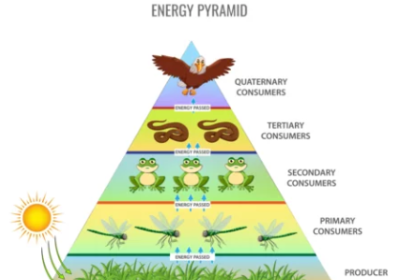

"The chain that feeds the world."
The Amazing Food Chain: Journey From Stone Age to Today
From Ancient Wisdom to Modern Science
Stone Age Discovery:
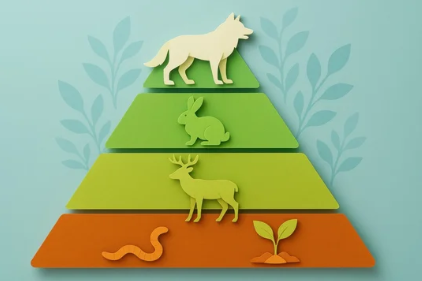
Thousands of years ago, Stone Age humans living in forests and caves were nature's first observers. They noticed something remarkable: grass fed deer, deer fed larger predators, and everything depended on the sun's energy. While they didn't use the term "food chain," these early humans understood that nature operates as a giant, interconnected circle of life. Their survival depended on this knowledge. They tracked animal movements, understood seasonal patterns, and recognized that every creature played a vital role in the natural world around them.
Scientific Foundation:
Fast forward to 1927, when British ecologist Charles Elton formally introduced the concepts of food chains and food webs to the scientific community. His groundbreaking research transformed our understanding of how energy flows through ecosystems. Since Elton's pioneering work, educators worldwide have developed engaging workshops to help children explore these natural connections. Today's Food Chain Workshop builds on both ancient observations and modern science to create memorable learning experiences.
Understanding Nature's Delicate Balance
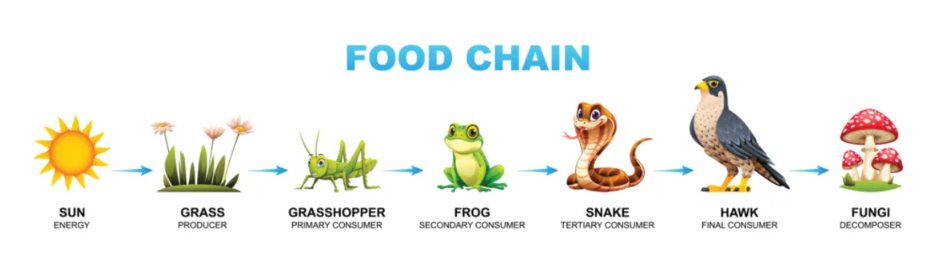
1. Sun Gives Energy
The Sun is the main source of energy for all living beings on Earth.
2. Plants (Producers) Make Food
Green plants use sunlight, air, and water to prepare their own food through photosynthesis.
3. Herbivores Eat Plants
Animals like deer, goat, and rabbit depend directly on plants for survival.
4. Carnivores Eat Herbivores
Animals like lions, tigers, and snakes depend on herbivores for food.
5. Top Predators Control Population
They keep the number of herbivores in balance so that plants are not overused.
6. Decomposers Break Down Dead Matter
Bacteria and fungi decompose dead plants and animals and return nutrients to the soil.
7. Nutrients Return to Soil
The recycled nutrients help plants grow again, continuing the natural cycle.
8. Oxygen–Carbon Dioxide Balance
Plants give oxygen, while animals release carbon dioxide—both are needed for life.
9. Water Cycle Supports Life
Evaporation, condensation, and rainfall ensure continuous water supply to living beings.
10. Each Living Being Has a Role
Even the smallest insect plays an important part in maintaining balance.
11. Disturbing One Link Affects All
If one species disappears, many others suffer due to broken food chains.
12. Human Actions Affect Balance
Deforestation, pollution, and overuse of resources disturb nature’s harmony.
13. Protection Restores Balance
Planting trees, saving animals, and reducing pollution help restore balance.
14. Interdependence Is the Key
All living and non-living things in nature depend on one another.
15. Balance Ensures Survival of Life
When nature stays balanced, all life on Earth remains healthy and sustainable.
Why Food Chain Education Matters?
Food chain education helps students understand how living beings survive in nature. It teaches that plants, animals, and humans are all connected through food and energy. This basic knowledge makes students aware that no living organism can survive alone. It explains the balance of nature in a simple way. When one link of the food chain is disturbed, many other living beings are affected. Through this, students learn that nature works like a well-connected system.
Food chain education also builds environmental awareness. Students understand why protecting forests, animals, rivers, and soil is important for life on Earth. It encourages them to respect nature and all living beings. It develops scientific and logical thinking in students. They learn about energy flow, ecosystems, and cause-and-effect relationships in a clear and practical way.
Food chains also connect learning to daily life. Students realise where their food comes from and how farmers, animals, and plants are all part of one system. Most importantly, food chain education teaches responsibility. Students learn that human actions like pollution, deforestation, and hunting can disturb nature’s balance, and that protecting the environment is everyone’s duty.
Article by- Priyanka
Related News