
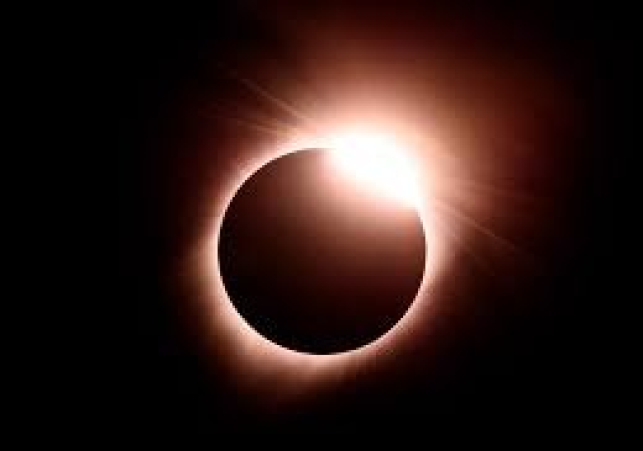
A Celestial Phenomenon that mesmerizes everyone!
Understanding Solar Eclipses
A solar eclipse is one of nature’s most fascinating astronomical events, where the Moon passes between the Earth and the Sun, temporarily blocking the Sun’s light either partially or completely. This alignment creates a shadow on Earth, allowing observers in certain regions to witness the dramatic dimming or disappearance of the Sun. Though it may seem mysterious, a solar eclipse is a well understood scientific phenomenon that highlights the precise movements of celestial bodies. A solar eclipse occurs when the Sun, Moon, and Earth align in a 'straight line', a configuration known as “syzygy.” During this event, the Moon casts a shadow on the Earth’s surface. This shadow has two main parts: the umbra, where the Sun is completely blocked, and the penumbra, where only part of the Sun is obscured. People located in the umbra experience a total eclipse, while those in the penumbra see a partial eclipse.
There are three main types of solar eclipses: total, partial, and annular. A total solar eclipse happens when the Moon completely covers the Sun as seen from Earth. During this brief period, the sky darkens dramatically, and the Sun’s outer atmosphere, known as the corona, becomes visible. A partial solar eclipse occurs when only a portion of the Sun is covered by the Moon, making it appear as though a “bite” has been taken out of the Sun. An annular solar eclipse takes place when the Moon is positioned farther away from Earth in its orbit. As a result, it appears smaller and does not completely cover the Sun, leaving a bright ring, or “ring of fire,” visible around the Moon.
The Moon plays a crucial role in creating a solar eclipse. Despite being much smaller than the Sun, the Moon can cover it perfectly due to its relative distance from Earth. The Sun is about 400 times larger than the Moon, but it is also about 400 times farther away. This unique coincidence allows the Moon to appear nearly the same size as the Sun in the sky, making total solar eclipses possible. Without this precise size-distance relationship, such spectacular eclipses would not occur. One might wonder why solar eclipses do not happen every month, given that the Moon orbits the Earth approximately every 29.5 days. The reason lies in the tilt of the Moon’s orbit. The Moon’s orbital path is inclined at about 5 degrees relative to Earth’s orbit around the Sun. Because of this tilt, the Moon usually passes slightly above or below the Sun from our perspective, preventing an eclipse. A solar eclipse only occurs when the Moon is near one of the two points where its orbit crosses Earth’s orbital plane, known as nodes, and aligns perfectly with the Sun and Earth.
Another intriguing aspect of solar eclipses is the “path of totality.” This refers to the narrow region on Earth’s surface where a total solar eclipse can be observed. The path of totality is typically only about 100 to 200 kilometers wide and moves across the Earth as the Moon continues its orbit. Observers within this path can experience total darkness for a few minutes, while those outside it will only see a partial eclipse. The movement of this path is influenced by the relative motions of the Earth’s rotation and the Moon’s orbit, making each eclipse visible from different parts of the world.
In conclusion, a solar eclipse is not just a beautiful spectacle but also a remarkable demonstration of cosmic alignment and precision. From the Moon’s essential role to the different types of eclipses and the science behind their occurrence, each aspect reveals the intricate workings of our solar system. Understanding why eclipses do not happen every month and how the path of totality is formed adds to the appreciation of this rare and awe-inspiring event. Solar eclipses remind us of the vastness of space and the delicate balance that governs celestial movements, offering both scientific insight and a sense of wonder.