Every drop has a journey! 'THE WATER CYCLE' : Nature’s Never-Ending Journey of Water

MySkool Times
Water is one of the most precious gifts of nature. Every living thing- plants, animals, and humans, needs water to survive. But have you ever wondered where water comes from and where it goes?
The answer lies in a beautiful natural process called the Water Cycle. It is the continuous movement of water from the Earth to the sky and back again.
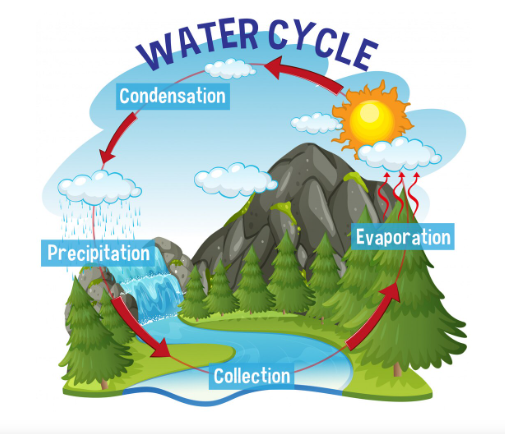
Step 1: Evaporation
Evaporation is the process in which water slowly changes into water vapour when it is warmed by the sun. This happens in rivers, lakes, oceans, puddles, and even in wet clothes. As the water gets heat, it turns into an invisible gas and rises into the air. Evaporation does not need boiling and can occur at normal temperatures. It helps dry clothes, cool our body through sweat, and plays an important role in the water cycle by moving water from the Earth into the atmosphere.
Step 2: Condensation
Condensation is the process in which water vapour in the air cools down and changes back into tiny drops of water. As warm water vapour rises higher into the sky, it meets cooler air. This cooling causes the vapour to turn into small water droplets or ice crystals, which come together to form clouds. Condensation is an important part of the water cycle because it helps store water in the atmosphere before it returns to the Earth. Without condensation, clouds would not form and rainfall would not be possible.
Step 3: Precipitation
Precipitation happens when the water droplets or ice crystals in clouds grow larger and heavier. As they join together, they become too heavy to remain floating in the air. When this happens, they fall back to the Earth due to gravity. Precipitation can occur in different forms such as rain, snow, sleet, or hail, depending on the temperature of the air. This stage of the water cycle provides fresh water that is essential for plants, animals, and human life.
Step 4: Collection
Collection is the stage in the water cycle where water gathers after precipitation falls to the ground. Rainwater flows into rivers, lakes, ponds, and oceans, while some of it seeps into the soil and becomes groundwater. This stored water is used by plants, animals, and people for daily needs. Over time, the collected water is heated by the sun and begins to evaporate again, continuing the water cycle and keeping nature in balance.
Why Is the Water Cycle Important?
The water cycle is extremely important because it keeps water moving through the Earth and the atmosphere, making life possible. Through processes like evaporation, condensation, precipitation, and collection, 'water is naturally purified and reused again and again'. The water cycle helps provide fresh water for drinking, farming, and daily use, while also supporting plants, animals, and entire ecosystems. It plays a key role in regulating weather and climate by controlling rainfall and temperature. Without the water cycle, water would not be evenly distributed across the planet, and life as we know it would not be able to survive.
Fun Fact for Young Readers
The same water you drink today may have once fallen as rain thousands of years ago!
Conclusion
The water cycle shows us how nature works in perfect harmony. It teaches us the importance of saving water and protecting our environment.
Every drop counts, because water is life!
Article by- Priyanka